
The Rent Squeeze: What Nigeria's 2026 Numbers Reveal
By
Abubakar Yarima
— CEO & Founder of Cribly
01 Oct 2026
•
4 min read
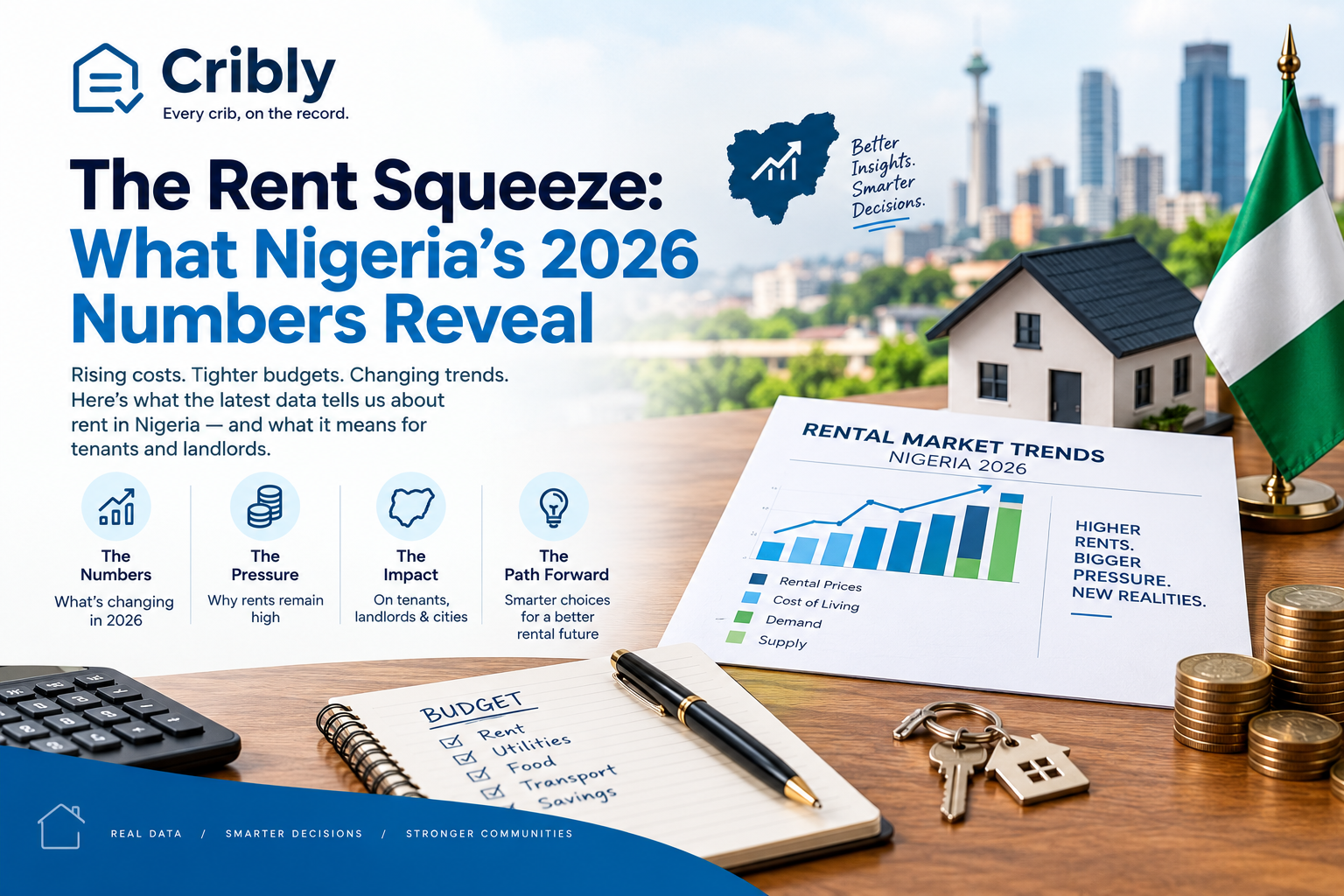
Nigeria's headline inflation has been cooling for months — the National Bureau of Statistics put it at 15.91% in June 2026, down from the highs of 2024. Yet if you have renewed a tenancy in Lagos this year, that number probably feels like a fantasy. Across the city, asking rents have climbed two to five times faster than the official inflation rate.
The headline number hides a rent story
According to listing data from Nigeria Property Centre, the median asking rent for flats in Lagos rose 22.3% year-on-year to June 2026. Drill into specific corridors and the gap widens: asking rents in Lekki jumped 47.8%, while mainland Yaba rose 28.9%. The pattern holds beyond Lagos — Abuja flats were up roughly 26% (to a ₦6.7M median) and Port Harcourt about 20.6%. An earlier private index from BuyLetLive had already clocked rental-apartment growth of 47.25% across 2024.
These are as-listed asking rents, not agreed prices, and premium stock skews the medians upward — Ikoyi's ₦36.7M "median" is nobody's idea of a typical flat. But the direction and the pace are unmistakable.
Cribly Market Snapshot
as of 01 Oct 2026
Live market figures will appear here as listings grow on the Cribly marketplace.
Live data from the Cribly marketplace · updated hourly
Why rents rise even as inflation cools
Three forces are doing most of the work.
- Building is far more expensive than it was. The 2023–24 naira float sent the currency from about ₦907 to the dollar to ₦1,535 by the end of 2024, and construction inputs followed. Cement — around ₦4,500–₦5,500 a bag in 2023 — now trades near ₦11,000–₦12,500. Cement makers reported their cost of production jumped 72% in a single year. New supply cannot come cheaply when the raw materials have doubled.
- The shortage is structural. The Federal Government's housing-data committee pegged the national deficit at roughly 15 million units in early 2026; broader estimates that include substandard homes run closer to 28 million. Nigeria needs an estimated 550,000 new homes a year — Lagos alone needs over 227,000 — and is building nowhere near that.
- Money is coming home. Diaspora remittances hit $20.93 billion in 2024, the highest in five years, and a meaningful share flows into property — gated estates, short-lets and buy-to-let — tightening the market for everyone else.
One nuance worth keeping straight: the "naira collapse is driving rents" narrative is really a 2023–24 story. Through 2025 and into 2026 the currency actually strengthened, to about ₦1,381 to the dollar by mid-2026. What keeps rents elevated now is the lagged cost of construction and the sheer shortage of homes — not a fresh currency shock.
The advance-rent question
The affordability squeeze has revived a long-running debate over the one-to-two-year rent that Nigerian landlords typically demand upfront. In late 2025 Lagos lawmakers introduced a Tenancy and Recovery of Premises Bill that would cap advance rent at one year for yearly tenancies (three months for monthly ones), require agents to register with LASRERA, and cap agent fees at 5% of annual rent. That bill was still a draft at the time of writing — not enforceable law — but it signals where policy is heading.
What it means if you own or manage property
For landlords, the data is a reminder that pricing to the market is not the same as maximising a single renewal. In a market this tight, the expensive event is a vacancy, not a modest rent — a reliable tenant who renews is worth more than an empty unit chasing a headline figure. For tenants, the widening gap between rent and income is the story of the year, and it is why transparency on what a unit actually costs — base rent, service charges and all — matters more than ever.
At Cribly we see these dynamics in real time across the units listed on our marketplace. The snapshot above updates as the market moves.
Figures cited are current as of July 2026 and draw on the National Bureau of Statistics, the Central Bank of Nigeria, Nigeria Property Centre and BuyLetLive. Market data moves quickly — check the latest before making decisions.
#rent
#lagos
#market data
#inflation